If you are worried about the growing presence of the far-right in your local area, it’s up to you to do something about it. No one else is going to, except maybe another handful of brave people in your community, and you won’t find them until you get out there and make a start.
The last few years should have rid you of any illusions that government, police, or media might make any real effort to combat the growth of fascism.
If you don’t have a local antifascist group, start one! Don’t be daunted or overwhelmed if you are lacking in experience. We all started out the same way.
The basics
The secret is to begin. Think about what you have the capabilities and capacity to do now, and start gaining experience. You’ll quickly build your skills and create opportunities to meet other antifascists that are out there doing the same.
A good way to start is with a sticker or poster campaign. This can have a powerful effect. It could be the first act in a long fight-back against ascendant local fascists, the point where the tide began to turn. This is also a good way to enhance your understanding of the area, and find and destroy any fascist graffiti or stickers whilst you’re at it.

Talk to your trusted friends about how you feel and what you want to do. Build an affinity group.
Consider your digital security and minimise your digital footprint.
Establish a small (and secure) web or social media presence, so that other local and neighbouring antifascists can find you. Keep your personal identity completely distinct from your antifascist organising. Fascists are stupid enough to organise directly on Facebook with their real names. Don’t be like them.
Learn from more experienced groups. Follow their webpages or social media content, or attend their demonstrations to learn how they do it.
Read up on guides and resources on this info site. Reach out to us for help if you need it.
Next steps
Think more deeply about your digital security, particularly in terms of social media and your phone. Ensure you are using Signal and Tor and a VPN, as a minimum. Do not organise or discuss your activity over WhatsApp, Discord, Instagram, or any other form of social media.
Do use social media and other online tools to gain information on local fascists. Check to see who is attending their events, and who they are connected to. Start to build a local picture of who the fascists are, and what they do.

Think about the relationships between street fascists and more ‘respectable’ far-right parties such as ReformUK. You don’t have to look hard to discover many parish, town, district and county Councillors, for example, will have links to the street fascists attempting to intimidate vulnerable members of your community.
Identify these links between the two and get the information out there. Use friendly media sources, poster campaigns, or whatever you can think of. This enables you to drive a wedge between their political and street wings, and weaken their movement.
You’ll also likely discover that many of the local far-right organisers (and sometimes even elected councillors) have unsavoury pasts that they have tried to keep quiet. Make a noise.
If your local fascists are organising under a particular slogan, deconstruct it. Break it down into what it really means, so that people can understand what fascist ideology actually represents.
Constantly re-evaluate the security culture in your group.
Consider setting up a research website to release the information you gather to the public. Sunlight is the best disinfectant. A Nazi suddenly worried about losing his job because his boss found out that he’s a Nazi, may simply decide to stop being a Nazi. Understand best practice for this work.
Learn self-defence and work on your physical fitness. Fascists are inherently bullies, and organising against them always carries the risk that they will attack you physically. Learn to defend yourself and turn the tables on them.
Enhance your understanding of antifascist theory, and why we’re in a fight not just against fascism, but also against global capitalism and the state, which are the source of the oppression and misery that allow fascism to take hold within the working class.
Make statements of solidarity with other antifascists or oppressed people.
Consider your goals and work towards them. Antifascism isn’t about aesthetics or glory, it’s about defeating fascism. Do what’s effective, and don’t chase clout or fame.
Make it fun. What better purpose in life could you have than taking action against an ideology of pure violence that seeks to crush and oppress us all? Taking direct action against fascism is a liberating experience.
Be an active antifascist in your community as part of your daily life. Antifascism needs to be embedded in our culture if we are to build real resistance against fascism. Start an explicitly antifascist sports team, or put on anti-racist music nights. Talk to a local venue and ask for a room to host antifascist film screenings.
The street
If you don’t stop fascists marching in the street, they eventually march into power.
Holding a counter-demonstration that doesn’t seek to actively stop the fascists from marching is not a good use of your time and energy. They’ll keep coming back until you stop them.
However, if you are planning on directly opposing fascists in the street, there are a number of extra things to consider.
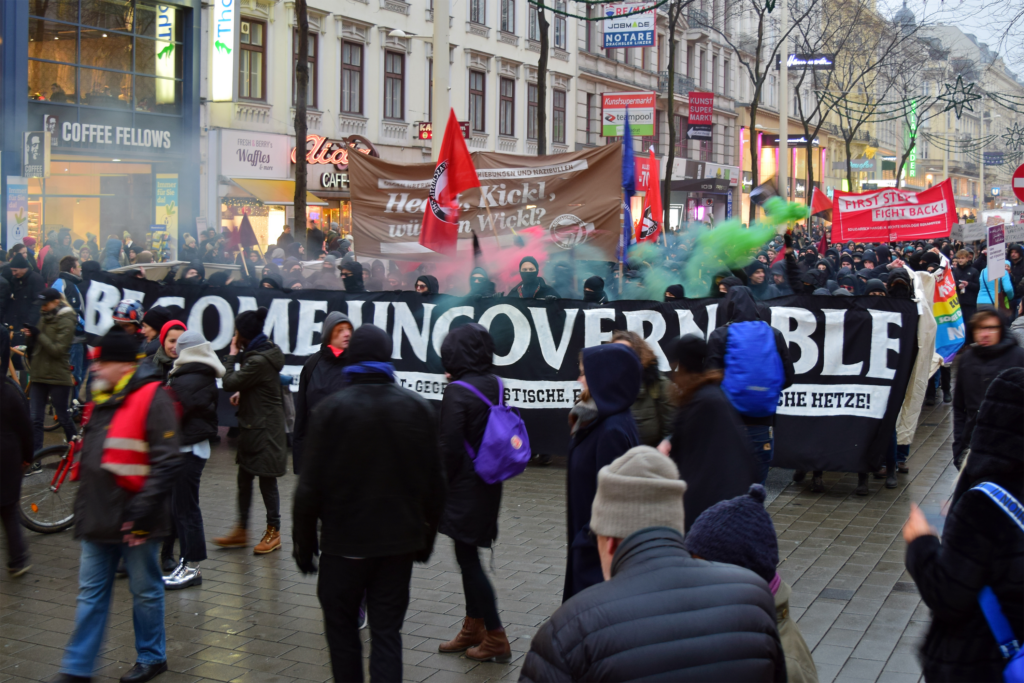
Consider your own safety and well-being and all the possible physical, mental and legal ramifications of what you are doing. This will be a long fight. Don’t get yourself knocked out of it early.
Consider alternative methods and techniques to street actions. Whilst manifesting an antifascist force in the streets is a beautiful thing, there are some circumstances where other methods to prevent fascists from gathering and marching may be preferable. Methods that may allow you to have your day to spend how you please, instead of standing on a freezing cold street.
Pick your battles carefully. If you are expecting to be heavily outnumbered, then consider what you can realistically achieve by being there, and the consequences of both being there or not being there. For example – are there vulnerable people in physical danger of being attacked by fascists if you don’t attend? If you do attend, is everyone in your group physically fit enough to be able to move quickly if things go wrong?
Always debrief and assess the effectiveness of your actions.
Use your creativity and initiative. There’s no perfect way to do this, and no experts. Effective antifascism requires constant learning and adjusting.
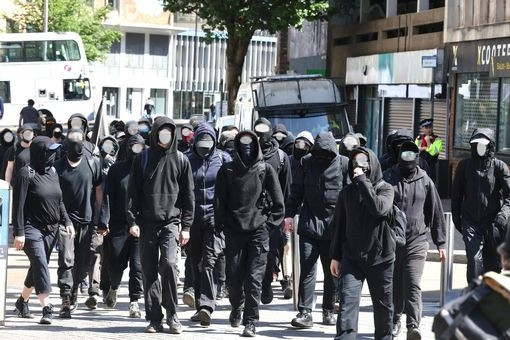
Consider your operational security, and protect your identity on the street as much as possible. How at risk are you at being matched to your online profiles if the fascists or the police gain pictures of you? What information is available about you, online or otherwise?
An unfortunate reality of fascist street activity in the 2020s is that most of them are recording the entire event, and many are streaming direct to YouTube or other platforms.
Consider strategies for how you deal with these streamers. One easy way to combat them is to loudly play copyrighted music so that they will only be able to post their video with the sound muted, meaning they’re not likely to gain many views or make money from it. As always, use your creativity in dealing with problems like these. There will be effective strategies that no-one has tried or even thought of yet.
Both the fascists and the police will review videos of protests in an attempt to discover your identity.
Although they can at times be valuable allies, remember that liberal antifascists (such as Stand up to Racism) often work with the police. The police are not your friends, in any circumstances. They are the violent arm of an increasingly authoritarian pre-fascist state.
As antifascists in the US are currently experiencing, as they encounter Proud Boys and Patriot Front members wearing ICE uniform; the fascists you face in the street right now could very easily be wearing police uniform in the future.
–Written by Antifascist Info, January 2026–
Resources and Links for New Groups
Setting up a group
How to form an affinity group – CrimeThinc
Organising Successful Meetings – Seeds for Change
Consensus Decision Making: a short guide – Seeds for Change
Security Culture
What is security culture? – CrimeThinc
Confidence. Courage. Connection. Trust. A proposal for security culture – Zine
Surveillance Self-Defence – EFF
Antifascism
40 Ways to Fight Fascists – Zine
30 Antifa Actions – Antifa International
Legal Rights, Care and Support
Know Your Rights and Legal Info – Green and Black Cross
Ways to provide care after a protest or action – Across Front Lines